
For reasons of equal opportunity, it is crucial that students receive an equivalent education in compulsory schooling across all cantons. While the cantons already coordinate many aspects of compulsory education, analyses show that significant differences still exist between curricula. A common language-regional curriculum would harmonize the competencies and content of instruction in kindergarten and primary school across the German- and multilingual cantons of Switzerland.
The BKZ office (Conference of Education Directors of Central Switzerland)https://www.regionalkonferenzen.ch/) kindly answered our most important questions about Curriculum 21:
What is Curriculum 21?
Curriculum 21 is the currently valid curriculum for all German-speaking cantons of Switzerland and the Principality of Liechtenstein, and thus represents the politically legitimized mandate of society for primary and secondary education. Through this common curriculum, the cantons have implemented the requirement of Article 62, paragraph 4 of the Federal Constitution, which mandates the harmonization of the school system. Curriculum 21 defines what students learn in each cycle and in each subject area and simultaneously serves as the basis for the development of teaching materials, a planning tool for teachers, and for their initial and continuing professional development. At the same time, it indicates to subsequent schools, training companies, and parents what children and young people should know and be able to do after each grade level.
How is Curriculum 21 structured?
Cycles: Curriculum 21 divides the eleven school years into three cycles. The first cycle comprises two years of kindergarten and the first two years of primary school (up to the end of second grade). The second cycle comprises four years of primary school (grades 3 to 6), and the third cycle comprises the three years of lower secondary school (grades 7 to 9).
Departments: Curriculum 21 is divided into six subject areas. Languages; Mathematics; Nature, Humans, Society (NMG); Design; Music as well as Exercise and sport The curriculum is structured. For each subject area, the competencies that students acquire during primary school are described. In the first cycle, instruction is strongly oriented towards the children's development and is organized and designed across subjects, especially at the beginning. Play plays a significant role. To reflect this focus, Curriculum 21 outlines nine development-oriented approaches for building upon the child's development and learning in the first cycle.
Module: In addition, Curriculum 21 contains the curricula for the modules Media and Computer Science as well as Career orientation. These modules encompass interdisciplinary tasks of the school and ensure a systematic development of skills for a core set of these tasks.
Interdisciplinary skills: Interdisciplinary skills are integrated into the subject-specific and module curricula. These include personal, social, and methodological skills.
Education for Sustainable Development (ESD): The subject-specific and module curricula include provisions for teaching under the guiding principle Sustainable development The following topics have been incorporated and marked with cross-references: Politics, democracy and human rights; Natural environment and resources; Gender and equality; Health; Global development and peace; Cultural identities and intercultural understanding; Economy and consumption.

Illustration: link
Where do you see the greatest advantages of Curriculum 21?
Dividing the school year into cycles takes into account the fact that a child's biological age rarely corresponds to their developmental level in other areas. This makes individualized support easier in Curriculum 21.
By focusing on competencies in Curriculum 21, the emphasis is increasingly placed on the applicability of knowledge, skills and abilities.
By describing learning objectives in the form of competency expectations, content is directly linked to the subject-specific and interdisciplinary skills and abilities to be acquired; knowledge and skills, subject-specific and interdisciplinary competencies are interconnected. This also brings into focus the acquisition, learning, and problem-solving processes that students need to develop these competencies.
All German-speaking cantons of Switzerland follow the same curriculum. This facilitates the mobility of families with school-age children and of teachers.
A common curriculum is a basis for the coordination of teaching materials and facilitates the joint development of teaching materials for German-speaking Switzerland.
A common curriculum It serves as a basis for the development of instruments for diagnostic performance measurement, which can be used throughout German-speaking Switzerland.
Are there any significant differences in the implementation of Curriculum 21 between cantons – for example, between the cantons of Zurich and Aargau?
The cantons bordering the language border introduce French as the first foreign language, the others English.
In the curriculum of the Canton of Aargau, the objectives for "Political Education" are listed as a module in the third cycle. In the curriculum of the Canton of Zurich, these are integrated into the subject area "Spaces, Times, Societies (RZG)."
The curriculum of the Canton of Zurich includes benchmarks in the middle of the first cycle (end of kindergarten). These benchmarks define which competency levels must be addressed by the end of kindergarten. They serve as a planning and orientation aid for teachers. The Canton of Aargau has refrained from setting benchmarks in the first cycle.
The teaching materials used vary from canton to canton. Decisions regarding teaching materials fall under the jurisdiction of the cantons.
The differences in the weekly timetables between the cantons have been further reduced by Curriculum 21. The determination of the weekly timetable also falls under the jurisdiction of the cantons.
What changes are coming into Curriculum 21 for kindergarten?
The introductory chapter of Curriculum 21 contains important statements on the design of lessons in the first cycle, which also highlight, for example, the importance of play for learning. Curriculum 21 is based in the first cycle on the kindergarten curricula and the curricula for the lower primary level that were valid at the time. In Curriculum 21, the first mandatory requirements are deliberately defined only for the end of the 2nd grade.
Curriculum 21 is designed as a subject-specific curriculum. But the lessons in the first cycle are oriented itself strong to the Development the Children and becomes before all to Beginn Organized and designed across disciplines. To take this orientation into account, nine development-oriented approaches to Curriculum 21 were presented, which start from and focus on the development and learning of the child in the first cycle.
The development-oriented approaches in Curriculum 21:
- Body, health and motor skills
- perception
- Time orientation
- Spatial orientation
- Relationships and regularities
- Imagination and creativity
- Learning and reflection
- Language and communication
- Autonomy and social action
These development-oriented approaches help teachers to find access to Curriculum 21 and build a bridge from the development perspective to the subject-specific structure of the curriculum.
Now we will show you using questions & Answers to the question of what infrastructure is needed to successfully implement Curriculum 21 in practice:
To what extent has the space requirement changed in connection with Curriculum 21?
New teaching methods and areas of responsibility (z.B. Curriculum 21) expands and changes the space requirements as well as the equipment of educational buildings, as well as their use and occupancy.
Thus, the minimum area requirements have also changed in connection with Curriculum 21, in the Olten School For example, the area of a classroom was increased to 75m2 and that of the group room to 37.5m2.
What impact will the introduction of Curriculum 21 have on school furniture?
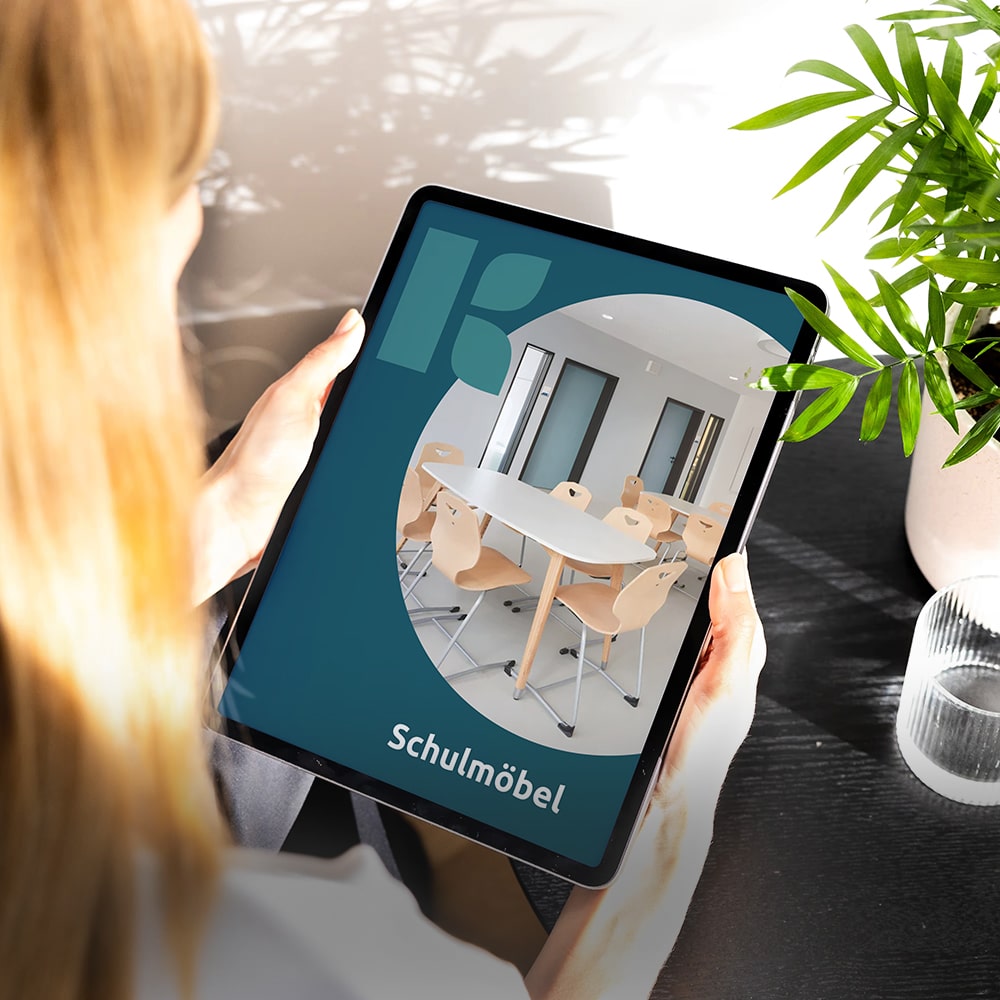
New school furniture should enable new ways of working in schools, not hinder them. School furniture must be adapted to the requirements of modern teaching.
Learning environments that adapt to the age of the children and promote age-appropriate learning are in demand.
How important is flexible classroom design for Curriculum 21?
The increasing prevalence of individualized work necessitates a growing number of individualized workspaces. Both individual and group workspaces must be able to be set up quickly. The focus is on fostering the students' self-responsibility and independence. This is supported by furniture that the students themselves can modify.
What characteristics must student chairs and desks fulfill in the new concept?
Although Curriculum 21 can be implemented with conventional student chairs and tables, new furniture helps to restructure lessons and implement new forms of learning.
Children appreciate furniture that can be moved easily, which means that school desks and chairs on casters are very popular; these also shouldn't be too heavy. The tedious task of moving heavy furniture should be a thing of the past.
Dynamic sitting This is also advantageous: Students need to be able to change their body position, which means chairs with the rocker mechanism are becoming increasingly in demand.

How should a teacher set up their classroom if they are teaching according to Curriculum 21?
The teacher with chalk in front of the blackboard? Those days are gone!
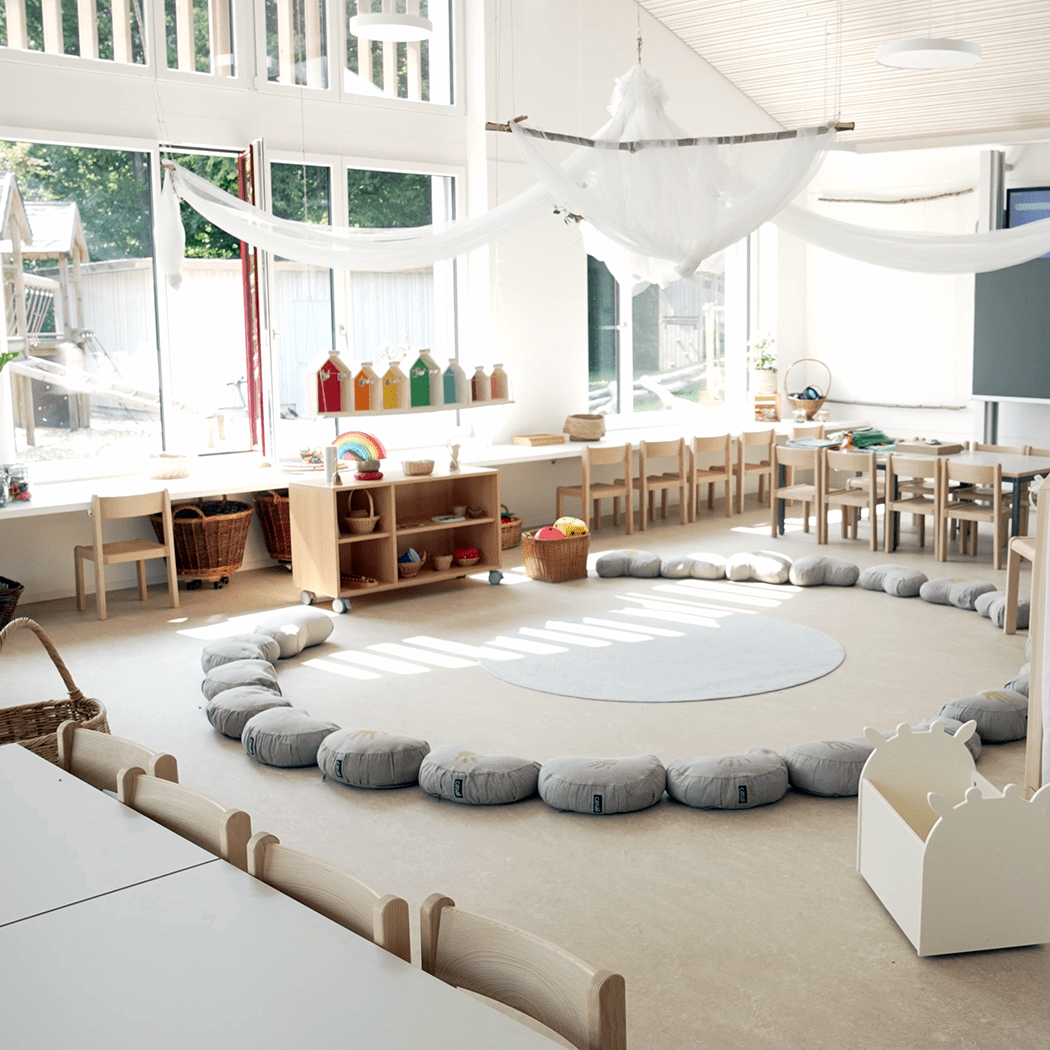
Nowadays, the classic classroom is no longer in demand; rather, the trend is moving towards open learning environments.
As in this example, where this was visualized over a very large area:

Besides the furnishing of the classroom, a coordinated color and furnishing concept is also important nowadays.
Curriculum 21 in kindergarten – What is its impact on kindergarten and are new kindergarten furniture pieces necessary?
Curriculum 21 applies from kindergarten to the end of schooling.
The acquisition of skills is now also structured according to subject area for the "Chindsgi" (kindergarten).
Kindergarten opens up new spaces for play and experience for the children, therefore the furniture must be carefully selected.
And finally...
Where can I find further information on Curriculum 21 at the cantonal level?
- Curriculum 21 Zurich
- Curriculum 21 Aargau
- Curriculum 21 Bern
- Curriculum 21 Lucerne
- Curriculum 21 SG
- Curriculum 21 Baselland
- Curriculum 21 Thurgau
- Curriculum 21 Solothurn
- Curriculum 21 Train
- Curriculum 21 Graubünden
- Curriculum 21 Valais
- Curriculum 21 Schwyz