

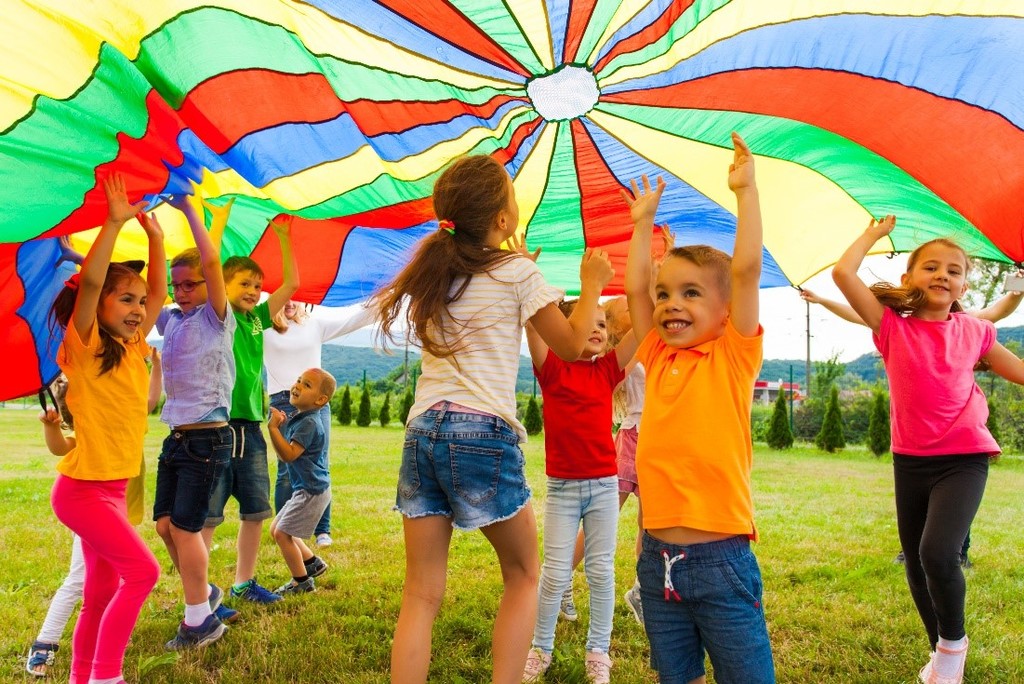
Icebreaker games, circle games and movement games for kindergartens and primary schools
Ready, set, go! Children's games are much more than just a pastime. Games prepare children for future life in a fun and engaging way.
Games train children's motor skills and memory, while simultaneously fostering their social and emotional competence. With a good children's game, even the youngest children learn that losing is just as much a part of life as winning.
1. How do games strengthen the group?
In mixed groups, games often serve to strengthen group cohesion and help children find their place within the group through play. Games also promote various skills in children, such as social competence, perception, and motivation.
We would like to welcome you as Kindergarten teachers and Teachers to give an overview of games that you can use when you come into contact with a new group and face the challenge of promoting team spirit.
Regardless of which group game is played, they all greatly promote teamwork.
2. Icebreaker games for kindergarten children
2.1 The fastest name game in the world
Game description: The players stand in a circle, and the kindergarten teacher holds a stopwatch. The teacher says their own name, then the person to their left says theirs, then their neighbor to their left, and so on, until the circle is complete. The teacher times how long it takes. After the first round, the players move closer together and try to beat the time. Once the time limit is reached, the teacher can conclude the game with a few questions: – Who knows one name? – Who knows two names? – Which name started with "A"? – How many "Yaels" were in the group?
Note: This game is not suitable for learning names! However, it's a great way to break the ice for groups of strangers, as it helps reduce awkwardness and create a relaxed atmosphere. The players getting closer together is especially important, as it helps break down barriers and fosters group cohesion!
2.2 Dice Migration
The children sit in a circle. The kindergarten teacher takes a foam cube, approaches a child, and hands it to them. As she does so, she greets the child: "Hello, my name is... and what's yours?" The child returns the greeting and states their name. Now it's that child's turn; their chair is removed from the circle. Each child who receives the cube is invited to join the circle and speaks to another child. This continues until a signal is given, such as clapping. Immediately, everyone tries to reach an empty chair. Those who can't start the next round.
2.3 I am looking for a friend
All players hold hands and form a circle.
One player starts the game.
He walks around the circle and says, "I'm looking for a friend to walk with me."
He then taps a teammate, who takes his hand and walks with him around the circle.
He asks this teammate: "What is my friend's name?"
The teammate now says his name.
They continue walking around the circle.
Now the friend who was just looking for a friend is looking for a new friend.
He says: "I'm looking for a friend to go with me."
He taps another teammate, who extends his hand and joins him.
He asks: "What is my friend's name?"
He answers.
The game continues in this way until the inner circle is dissolved.
The game continues.
The first player now says: "I'm looking for a friend named Etienne."
The player with this name breaks away from the queue and holds onto the free hand of the first player.
Now Thomas leads the line and says, "I'm looking for a friend named Levin."
Levin breaks free from the queue, grabs Etienne's free hand, and leads the queue.
And so forth.
3. Icebreaker games for school and 1st grade
3.1 Gummy bears
The teacher passes around a bag of gummy bears or hard candies. Each child can take as many as they like, but they should keep them in their hand and not eat them immediately. After the bag has been passed around, the teacher reveals the answer: Each child takes a turn sharing as many things about themselves as they took gummy bears. First their name, then characteristics, hobbies, favorite animal, etc.
3.2 Packing a suitcase in a different way
The well-known game "I'm packing my suitcase" requires some mental acrobatics, which can be stressful for younger children. However, the game can be made easier: Various objects, toy animals, crayons, etc., are placed on a table. Each child takes an object before everyone sits in a circle. One child says their name, places their object in a shallow basket, and says, for example: "I'm Lenny, and I'm packing a gorilla."
Then the basket continues to be passed around the circle. The contents and names are repeated. The second child says: "Lenny's gorilla is in the basket. My name is Lea and I'm packing an eraser."
The fuller the basket, the more difficult it becomes, but the visible items help jog the memory.
3.3 Partner interview
This game requires good listening skills. First, pairs are randomly drawn. Each pair then has about 20 minutes to talk to each other and learn something about the other person. Afterwards, everyone gathers in a circle and each child introduces their partner.
4. Movement games for kindergarten children
4.1 Petrified
Here's how it works: One child is the game leader (the kindergarten teacher is welcome to join in too). All the children run around. As soon as the game leader shouts "Freeze!", everyone must freeze in their current position. The first child to move becomes the game leader in the next round.
“Petrified” is funniest when the players move around as crazy as possible and/or make funny faces.
4.2 Who is afraid of the bad man?
Here's how it works: A playing field is agreed upon. One child is the "bad man" and stands on one side of the field, the other children on the other side. Then a question-and-answer game begins: Bad Man: "Who's afraid of the bad man?" Children: "Nobody!" Bad Man: "But what if he comes?" Children: "Then we'll run away!" At this point, all the children run and try to reach the end of the playing field before the bad man "high-fives" them. The children who are touched by the bad man help him catch them in the next round until only one child remains. This child becomes the "bad man" in the next round.
4.3 Mother cat and kittens
The mother cat is lying on the floor, "asleep" (and snoring loudly). The cheeky little kittens approach her on all fours.Suddenly, the mother cat wakes up and tries to catch one of her kittens, naturally having to move around on all fours. The captured kitten becomes the new mother cat.
5. Movement games for children from school
5.1 Olympic heptathlon
This game requires some preparation. It's played in the gym or on the school grounds. The children go through seven stations, each requiring a different movement technique: balancing, for example, on an overturned balance beam; jumping with a sack; crawling through a tunnel; running quickly to a marker and back; rolling, either sitting or lying on a wheeled board; jumping with a rope; and throwing a small ball at a pyramid of cans. Finally, there's a celebratory awards ceremony.
5.2 Gordian Knot
Here's how it works: All the children form a circle. Then everyone closes their eyes, stretches their arms forward, and tries to find another child's hand with each hand. The goal is to then untangle the knot as best as possible without letting go of each other's hands. In larger groups, one player can be the leader.
5.3 Chain catching
As in "normal" tag, one player is the catcher and tries to catch the other players by touching them. The touched player then gives the catcher their hand, and they continue catching in pairs. The "chain" of catchers grows longer and longer until all the children are caught and part of the chain. Optionally, the chain can split after every four players, creating several chains of two or three players each.
6. Circle games for kindergarten
6.1 Elephant-fant-fant
«Elephant-fant-fant comes running-running-running
with the long, long, long, long trunk.
I wanted to get out, out, out of the house, house, house.
Unfortunately, I didn't have a key.
Poor elephant, you ran so far,
"As consolation, I'll give you a piece of sugar."
Here's how to play: One child plays the elephant. They hold their nose and stick their other arm through the opening to form their trunk. While the song plays, the elephant walks around in a circle. At the end, all the children hold their hands out in front of them, pretending to hold a sugar cube. The elephant goes to one child and eats the sugar cube from their hand with their trunk. That child is now the elephant.
6.2 Horse racing
All players sit in a circle and act as riding horses by clapping their hands on their thighs.
The kindergarten teacher says:
All horses are starting.
"Ready, set, go (starting signal)!" (Show pistol gestures with hands and make a shooting sound)
The horses are running. (Clapping on thighs)
They jump over an obstacle. (Raise your hands while jumping over the obstacle)
They keep running.
There's a curve coming up. (Lean your body into the curve)
They continue galloping.
Spectators wave from the sidelines. (Waving)
The horses continue running.
There are photographers (depicting a camera and clicking, clicking, clicking)
Suddenly they are riding through mud (making a pft, pft, pft sound with their mouths).
The horses are now on the home straight and are running very fast again.
Ten meters to go.
9 meters to go. (counting down: 10, 9, 8, 7, 6, …)
Done !!!
The horse with starting number "9" is the winner.The winner rides a victory lap and waves to the spectators.
6.3 I spy with my little eye something
All the children sit together (possibly in a circle).
A child begins and says: "I spy with my little eye something that is green (color example only)."
The others now guess what is green around them. z.B. the pen, the pillow, the mineral water bottle, the leaves of the plant,…
Whoever guessed the correct thing is next in line.
You are currently reading an article about: movement games for children, icebreaker games for school, circle games for kindergarten, circle games, movement games, kindergarten games, icebreaker games
Most popular lapbooks for creative learning success