






German grammar distinguishes between different parts of speech. This article provides teachers with exercises, games, and overview lists of these various parts of speech.
Kibemo Wiki - Table of Contents
1 Parts of speech
1.1 List of nouns
1.1.1 Masculine nouns
1.1.2 Feminine nouns
1.1.3 Neutral nouns
1.1.4 The 4 cases - nominative, genitive, dative and accusative
1.2 Verb List
1.2.1 Present tense (present)
1.2.2 Preterite (past tense)
1.2.3 Perfect tense (present perfect)
1.2.4 Pluperfect (Perfect Past)
1.2.5 Future I (Future)
1.2.6 Future Perfect (completed future)
1.2.7 Auxiliary verbs
1.2.8 Modal verbs
1.3 List of adjectives
1.3.1 Adjectives are comparative and superlative forms.
1.3.2 The predicative use of the adjective
1.3.3 The adverbial use of the adjective
1.4 Pronoun List
1.4.1 Personal pronouns
1.4.2 Reflexive pronouns
1.4.3 Possessive pronouns
1.4.4 relative
1.5 Particle list
1.5.1 Degree particles
1.5.2 Focus particles
1.5.3 Modal particles
1.6 The top exercise sites
1.6.1 Noun Exercises
1.6.2 Verb Exercises
1.6.3 Adjective exercises
1.6.4 Pronoun exercises
1.6.5 Particle Exercises
1 Parts of speech
In Switzerland, a distinction is made between different parts of speech.
There are parts of speech that can change their form, while others remain unchanged.
We present the most important ones to you:
| noun | Man, dog, rose, house, newspaper, water, wood, Klaus, Bavaria, love |
| Verbs | write, travel, shop, read, understand, become, be able, fly |
| Adjectives | old, fierce, friendly, proud, German, female, beautiful, yellow, important |
| pronoun | I, he, these, one, which, a, my, someone, no one, themselves |
| Particles | even, indeed, just, quite, very, also |
1.1 List of nouns
Objects, living beings, and even invisible things are nouns. Nouns can be objects like a blackboard, a truck, or apples, but also invisible, abstract, imagined things like love, confidence, and fun. Nouns have an article (the, a, a, a, etc.).
| Examples: Persons (human beings) are nouns: Man, woman, child, Anna, Thomas, Mia, Luca Animals are nouns: Mouse, dog, bear, fish, bird Things and plants are nouns: cactus, fir tree, tree, house, table, book |
1.1.1 Masculine nouns
Masculine (male) - the man, the barrel, the donkey, the ring, the saying, the sentence, the rain, the lid, the dream, the alarm clock, the wind, the moon...
1.1.2 Feminine nouns
Feminine (female) - the sun, love, woman, enlightenment, flower, barrel, traffic light, ceiling, rating, grade...
1.1.3 Neutral nouns
neuter (neuter) - the child, the result, the weather, the cloth, the nest, life, the word, the pendulum, the sheet, the plumb line, the knife...
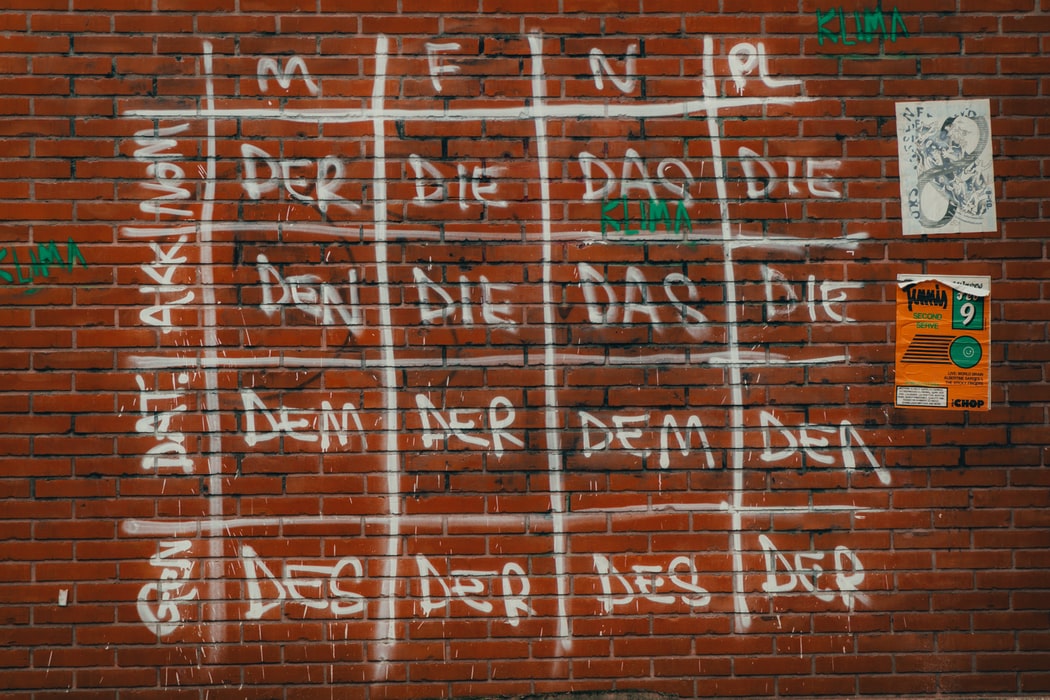
1.1.4 The 4 cases - nominative, genitive, dative and accusative
| case | Masculine | Feminine | neuter |
| nominative (1st case) | the man | the woman | the child |
| genitive (2nd case) | the man | the woman | the child |
| dative (3rd case) | the man | the woman | the child |
| accusative (4th case) | the man | the woman | the child |
1.2 Verb List
Verbs describe what happens or a state. Verbs have a base form (infinitive). Verbs are also called Action words, or time words. Verbs are always written in lowercase, unless they are used as nouns. The ending of a verb in the infinitive is usually -en, The ending is very rare -n
| Examples: runen, goen, seeen, lifeen, gameen, sailn, hailn, celebrationn. .. |
1.2.1 Present tense
The present tense describes what is happening right now. It also describes facts: Hamburg is located on the Elbe River.
| Examples: I'm telling my father about the accident. She's writing a letter right now. You have a mark on the tip of your nose. |
1.2.2 Preterite (past tense)
When writing about or telling a story about the past, the preterite (past tense) is used.
| Example: |
1.2.3 Perfect tense (present perfect)
When you talk about something that has already happened, you use the present perfect tense. Many verbs in the perfect tense are formed with "haben" (to have).
| Examples: I asked, we were asleep, you saw |
Many verbs of locomotion (go - I) am gone, running - I am walked, flying - we are flown) will be with 'be' educated.
1.2.4 Pluperfect (Perfect Past)
When describing an event in the past and wanting to indicate that something happened beforehand, the pluperfect tense is used. The pluperfect is formed with the simple past tense of 'haben' (I had said) and 'sein' (I had been).
| Examples: Before I went to school, I had already been to the kiosk. I had fallen asleep before the teacher came into the classroom. |
1.2.5 Future I (Future)
Future I is formed with the auxiliary verb 'werden' and the verb in the infinitive.
| Examples: I'm going swimming tomorrow. |
1.2.6 Future Perfect (completed future)
If you want to report on something that will end at a specific point in the future, then you use the future perfect tense.The future perfect tense is formed with 'werden', the past participle and the auxiliary verbs haben/sein in the infinitive.
| Examples: I will have gone swimming tomorrow afternoon. |
1.2.7 Auxiliary verbs
Auxiliary verbs are: haben, sein, werden. Compound tenses can be formed using auxiliary verbs.
| Examples: I just arrived. |
Auxiliary verbs can also stand alone with an adverb, noun, or adjective.
| Examples: She's upstairs. Our class is having fun. He is happy. |
1.2.8 Modal verbs
Verbs also exist as Modal verbs. Modal verbs are: wollen (to want), sollen (should), müssen (must), dürfen (may), können (can), mögen (like). They can also be used with the base form of a other verbs They stand. Then modal verbs explain how a sentence should be understood.
| Examples of the use of modal verbs with and without another verb: I likes Cocoa. We want away. I will call. Cara should ask. We must now start. I may more sweets eat. She will home run. Markus should now come. Can you learn? |
1.3 List of adjectives
Adjectives describe Things and living beings in more detail. Adjectives are written in lowercase.
| Examples: the beautiful flower, the little boy, the big house |
Adjectives change their endings when they are replaced by a noun. is changed from singular to plural.
| Examples: the fast train - the fastn Trains |
1.3.1 Adjectives are comparative and superlative forms.
| Basic level | Level of improvement | Maximum level |
| fast | faster | fastest |
| dear | Dear | rather |
| nice | nice | nicest |
| Examples: The picture is beautiful. |
The irregular comparison of adjectives
| Positive | comparative | superlative |
| good | better | preferably |
| much | more | the most |
| high | higher | the highest |
| close | closer | the next |
1.3.2 The predicative use of the adjective
The adjective is part of the verb (predicative use)
When an adjective is used as part of a verb, it follows the noun and is not inflected (declined). With verbs remain, be or become The adjective does not change.
| Examples: She is nice. He is old. |
1.3.3 The adverbial use of the adjective
An adjective is closely related to the verb (adverbial use of the adjective)
When an adjective modifies a verb, it is not inflected (declined). Here too, the adjective follows the noun.
| Examples: The man laughs loudly. |
1.4 Pronoun List
pronoun (Pronouns) stand for a Nouns. Pronouns prevent noun repetition. Pronouns can also accompany nouns.
| Examples: TIMO is his birthday today. He is his birthday today. |
We'll explain the 4 most important pronouns.
1.4.1 Personal pronouns
The personal pronouns ring I you he she it we you they. Personal pronouns can also be used in various cases decline. (Example: I give you the book (incorrect). I give you the book (correct).)
| Examples: I do it mine Tasks. |
1.4.2 Reflexive pronouns
The reflexive pronoun It refers back to the subject (reflexive = referring back). Reflexive pronouns occur in the dative and accusative cases. In the first and second person and in the genitive of the third person, the reflexive forms agree with the forms of the personal pronoun.
| I | you | he she | we | her | she | |
| dative | me | you | itself | us | you | itself |
| accusative | me | you | itself | us | you | itself |
1.4.3 Possessive pronouns
Possessive pronouns determine ownership and are based on the person they refer to or a thing.
| Personal pronouns person | Possessive pronouns |
| I 1st person singular | my |
| you 2nd person singular | your |
| he 3rd person singular | be |
| she 3rd person singular | her |
| it 3rd person singular | be |
| we 1st person plural | our |
| her 2nd person plural | your |
| she 3rd person plural | her |
1.4.4 relative
Relative pronouns such as the, the, the, which, which, which, who and What Relative pronouns appear at the beginning of a relative clause. "Der," "die," and "das" are the most common relative pronouns. The relative pronoun refers to a preceding noun or group of nouns.
| Examples: The people, whose Fate, which we do not know, remains unknown. |
1.5 Particle list
As Particles are words that not They can be inflected (conjugated). For example, they can be used to express personal feelings in a sentence. Sensations, Opinions and the degree expressing something and are primarily used in spoken Language is an important component. Particles include adverbs, prepositions, conjunctions, and interjections. They are no own sentence elements and they can not be asked.
Particles have usually no grammatical function.
| Examples: just, stop, yes, once, at all, probably, just, exactly, but, completely, only, because, even etc. |
Particles can be divided into the following groups:
1.5.1 Degree particles
Degree particles Adverbials provide information about the degree, or strength, of something. They are very often used in conjunction with adverbs or adjectives.
| Examples: very, somewhat, too, quite, totally, rather, absolutely, extremely, completely, unusually, somewhat, enormously, hardly, etc. |
1.5.2 Focus particles
Focus particles allow for the highlighting or limitation of a specific part of a statement.
| Examples: unique, at least, precisely, also, merely, only, at least, at best, just, above all, etc. |
1.5.3 Modal particles
Modal particles (Modal particles) give a statement a personal touch, i.e. they can reflect the speaker's attitude.
| Examples: well, yes, but, wait, because, sometimes, actually, maybe, just, probably, at all, etc. |
1.6 The top exercise sites
1.6.1 Noun Exercises
The Swiss website for interactive learning with helpful exercises on nouns: https://www.ilern.ch/nomen/
1.6.2 Verb Exercises
Grammar exercises for conjugating verbs:
https://mein-deutschbuch.de/grammatikuebungen-verbkonjugation.html
1.6.3 Adjective exercises
Free worksheets on adjectives:
https://www.grundschulkoenig.de/deutsch/2-klasse/adjektive-wiewoerter/
1.6.4 Pronoun exercises
Grammatical exercises on the word formation of pronouns:
https://www.schularena.com/deutsch/grammatik/wortlehre/pronomen
1.6.5 Particle Exercises
Interactive exercises on particles: https://www.schularena.com/deutsch/grammatik/wortlehre/partikel