


The complete interview for further reading:
What problems arise when rooms are furnished too rigidly?
If rooms are furnished too rigidly, children lack freedom of movement. Too much furniture, narrow aisles and always the same seating prevent children from moving naturally, experimenting and developing.
Children with a high urge to move feel this particularly strongly. If everyone sits on the same chairs and the room allows for little change, active learning becomes unnecessarily difficult.
Typical consequences are:
- less freedom of movement
- more restlessness
- less concentration
- restricted self-regulation
- too little space for spontaneous forms of learning
Children don't just need a seat. They need spaces that allow for different postures, short bursts of movement and active learning.
Which furniture and materials support active learning?
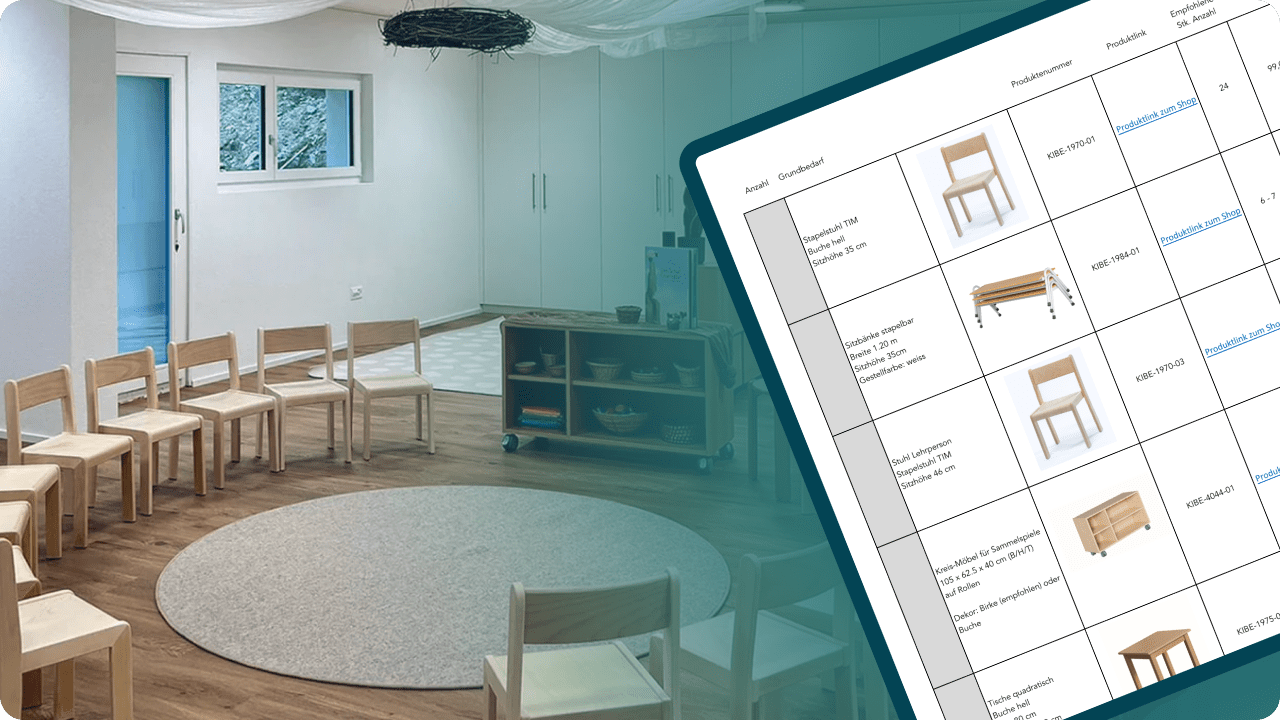
Active learning often begins with simple, flexible furniture. Kindergarten benches are particularly helpful because they are versatile.
Benches can:
- be used in a circle
- serve as small work tables
- be pushed together to form group tables
- invite balancing
- enable movements such as climbing, jumping or crawling through
Different seating options also bring movement into everyday life. These include, for example:
- exercise balls
- chairs on wheels
- balance boards
- floor tables
- windowsill workspaces
- stacking stones
- balance beams
- small trampolines
It is important to think bravely and creatively. Not every child has to sit in the same way. The more possibilities a room offers, the better children can regulate their urge to move.
Are kindergarten benches just a trend or are they useful in the long term?
Kindergarten benches are more than a short-term trend. They fit very well into a dynamic kindergarten routine because they are flexible, robust and versatile.
In a circle, benches allow for different postures. Children can sit, lean, move or work on the floor. At the same time, benches can be quickly rearranged and used for group work, movement games or open spaces.
Especially in kindergarten, where movement, play and learning are closely linked, benches offer significantly more possibilities than rigid individual chairs.
Why is active learning still too rarely implemented in practice?
Many teachers know that movement is important. Nevertheless, active learning is often not consistently implemented in everyday life.
The reasons are varied:
- limited budget
- too little space
- rigid furniture
- lack of products in the range
- little further training
- decisions are often not made by teachers
If 20 identical chairs are automatically ordered when new furniture is purchased, hardly any new movement opportunities arise. Therefore, more awareness is needed from all individuals who decide on furniture and room design.
Active learning should not be seen as an add-on. It is an important part of a child-friendly learning environment.
How can active learning be promoted with small steps?
It doesn't always take a complete refurnishing. Often, small changes are enough to enable children to move more.
Simple ideas are:
- stretch a rubber band between chair legs
- purchase a balance board
- use stacking stones as seating and movement material
- replace individual chairs with benches
- test flexible seating options
- reduce furniture to create space
- consciously plan short movement phases
It is important to simply start. Schools can test with a few materials how children react to them. If the offerings are well used, further purchases can be budgeted specifically.
What feedback is there from schools regarding active learning?
A common feedback is that teachers have too little space for movement. Rooms appear small, groups are large, and hallways or changing rooms often cannot be used freely due to safety reasons.
At the same time, it is clear that more space is often created when rooms are consistently furnished according to the principle of less is more. When furniture is reduced, open spaces are created for movement, play and active learning.
An example illustrates this: In a classroom of around 70 square metres, there is often very little space left per child if furniture, cupboards, washbasins, shelves, materials and children are included. This is hardly enough for real well-being and movement.
That's why it takes courage to think about rooms differently:
- do not plan a permanent workplace for every child
- use windowsills and floor areas
- push flexible furniture to the side
- use benches instead of many individual chairs
- integrate movement consciously into the daily routine
Active learning is not only achieved through more space. It is also achieved through different decisions.
Conclusion: Active learning requires courage, flexibility and open spaces
Children don't just learn by sitting. They learn through movement, trying things out, balancing, changing posture and physical activity.
For active learning to be possible in kindergartens and classrooms, rooms that are not too rigidly furnished are needed. Flexible furniture, different seating options and open spaces make a big difference.
Even small steps can help. Reducing furniture, using benches or adding movement materials creates more opportunities for concentration, self-regulation and enjoyment of learning.