




The complete interview to read:
How do you know it's time for new kindergarten chairs?
New kindergarten chairs usually become an issue when a kindergarten is being renovated, updated, or newly built. Many kindergarten chairs are in use for 20 years or more. Functionally, they are often still usable, but the many years of use are clearly visible.
Typical signs include:
- the chair wobbles or appears unstable
- the surface is heavily worn
- edges or lacquer are damaged
- the furniture no longer fits the room concept
- in new constructions or renovations, the furnishings are renewed
Precisely because kindergarten chairs are used daily, it is worth paying attention to quality and durability when making a new purchase.
What requirements must a good kindergarten chair meet?
A good kindergarten chair must withstand a lot in everyday life. It is used for snacks, crafts, playing, eating, in circles, and at work tables. Therefore, ergonomics, safety, and workmanship are most important.
Important requirements are:
- ergonomic seat shape
- rounded corners
- stable construction
- sturdy design
- high-quality wood processing
- durable surface
- good value for money
- tested quality
A molded seat shell and a suitable backrest support a comfortable sitting posture. At the same time, kindergarten chairs should be robust enough to remain in use for many years.
What should you pay attention to when comparing kindergarten chairs online?
Those looking for kindergarten chairs online should not only pay attention to the price. It is crucial whether the chair is tested and suitable for intensive daily use in kindergarten.
Helpful criteria are:
- tested according to DIN standard
- visible information on seat height
- stable wood joints
- rounded shapes
- ergonomic backrest
- high-quality lacquer finish
- clear product photos
- information on stackability
- glides to protect the floor
Especially with wooden chairs, it is worth taking a closer look at the workmanship. Solid wood for load-bearing parts and molded birch plywood for the seat and backrest are proven solutions.
Color-lacquered chairs can look attractive at first, but often show significant signs of wear after years. For a long lifespan, classic wood with a robust lacquer finish is usually the better choice.
What seat height is appropriate for kindergarten chairs?
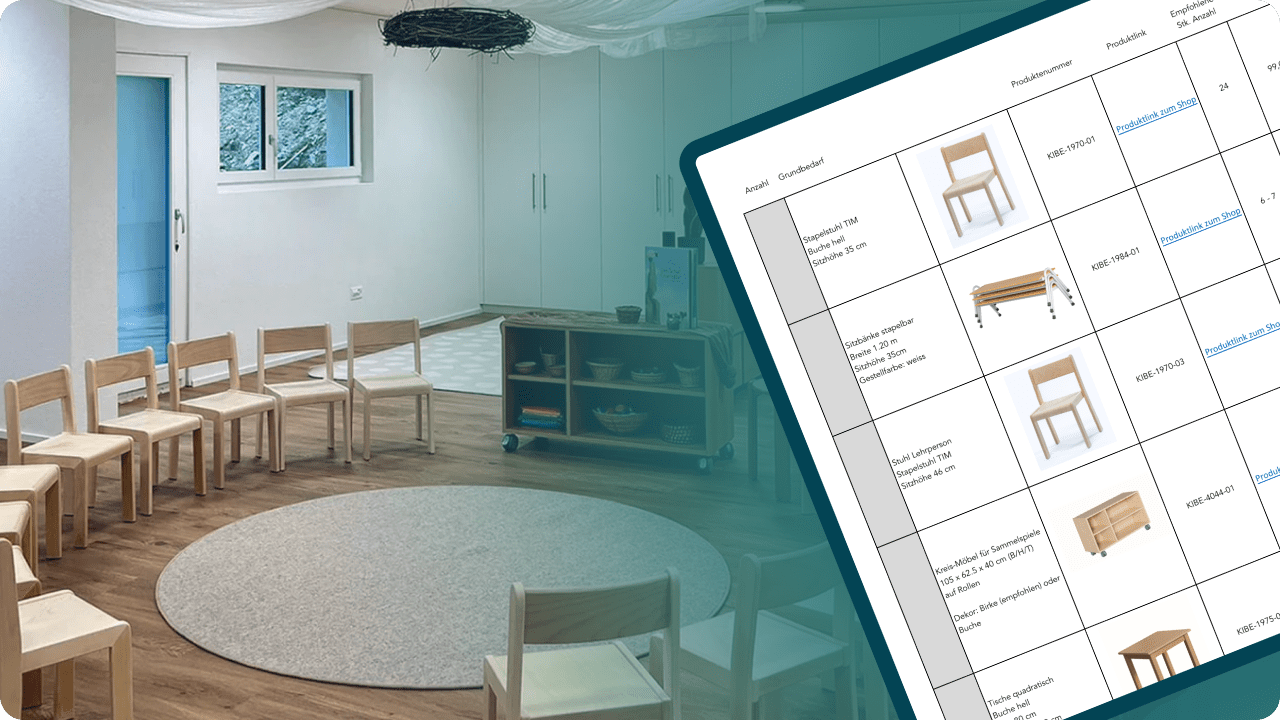
For most kindergartens in Switzerland, a seat height of around 34 to 35 cm is suitable. This generally matches a kindergarten table with a table height of approximately 59 cm.
This is the standard solution used in many kindergartens. For smaller children, a lower seat height of about 31 cm may also be useful. Usually, only a few chairs of this size are needed.
As a guideline:
- 34 to 35 cm seat height for most kindergarten children
- 59 cm table height as a suitable combination
- 31 cm seat height for smaller children
- only use different heights where they are actually needed
It is important to always consider the chair and table together. Only then can children sit ergonomically and rest their feet comfortably.
Which materials and models have proven successful?
Classic wooden chairs have proven particularly successful in kindergartens. They are sturdy, durable, and fit well visually into child-friendly rooms.
Proven variants are:
- solid wood chairs
- wooden chairs with a molded seat shell
- models with plywood
- light wood surfaces
- chairs with a linoleum seat as an addition
Linoleum on the seat surface is a newer variant. It can help with more restless children because the surface is less slippery. At the same time, it offers acoustic advantages because noises can be better dampened. This variant is still more of a trend and less widely established.
Plastic chairs are less recommendable. They are less common in kindergartens in Switzerland and often do not achieve the same quality and durability as high-quality wooden chairs.
Are stools or kindergarten benches a good alternative?
Stools and kindergarten benches can be a good addition but do not replace the classic kindergarten chair in every situation.
A stool offers flexibility and can be useful for short periods. However, if children sit, work, or stay in a circle for longer, a backrest is helpful.
Kindergarten benches are becoming increasingly popular, especially in the sitting circle. Several children can sit on them, and the benches can be used flexibly. Nevertheless, the kindergarten chair remains an important basic element for work tables, craft areas, and eating situations.
A combination of:
- classic kindergarten chairs
- kindergarten benches in the circle
- individual stools
- flexible seating options
- workplaces with backrests
This creates more variety without sacrificing basic ergonomic equipment.
What qualities do customers particularly appreciate in kindergarten chairs?
In practice, five qualities are particularly valued: ergonomics, safety, stackability, workmanship, and floor protection.
A good kindergarten chair should be:
- comfortable and ergonomic
- stable and safe
- stackable
- not scratch when stacked
- have plastic glides or felt glides
- cleanly finished
- ideally have no visible screws
- durable long-term
Stackability is particularly important in everyday kindergarten life. When rooms are cleaned, rearranged, or prepared during holidays, chairs must be storable in a space-saving manner.
Even small details make a difference. Felt between stacked chairs prevents scratches. Glides protect the floor and reduce noise.
What can go wrong with a kindergarten chair?
With high-quality kindergarten chairs, complaints are rare. If problems occur, they are often related to improper care or too much moisture.
Wood is a natural product. If the seat is cleaned too wet and moisture remains, the material can easily swell. Therefore, a kindergarten chair should not be cleaned with too much water or aggressive cleaning agents.
Recommendation for care:
- clean dry or only slightly damp
- do not use aggressive cleaning agents
- immediately remove standing moisture
- wipe dry after damp cleaning
- regularly check wood surfaces
Color variations are also normal with wood. Legs, seat, and backrest can consist of different types of wood and therefore appear slightly different. This is part of a natural material.
How does the procurement of kindergarten chairs work?
The procurement process depends heavily on the size of the municipality. In smaller municipalities, kindergarten teachers or school administrations often order directly. In larger municipalities, procurement often takes place through tenders.
A kindergarten chair is fundamentally a self-explanatory product. Nevertheless, it is worth checking the most important criteria before ordering:
- required quantity
- seat height
- suitable table height
- certification
- material
- stackability
- delivery time
- budget
Proven and tested models significantly reduce the risk of incorrect procurement.
How do you justify the purchase of high-quality kindergarten chairs?
A high-quality kindergarten chair is a long-term investment. If a cheap chair has to be replaced several times in 20 years, it can end up being more expensive than a stable quality product.
The following points help with the argumentation:
- longer lifespan
- tested safety
- better ergonomics
- fewer replacement purchases
- more stable workmanship
- lower complaint risk
- better value for money over the years
Important: The most expensive chair is not automatically the best. Quality, ergonomics, safety, and tested workmanship are crucial.
What budget should one expect?
For a kindergarten, usually about 24 to 36 kindergarten chairs are needed. The exact number depends on whether each child needs their own chair or whether chairs are flexibly used between the circle, workstations, and other areas.
As a rough guideline, a high-quality kindergarten chair costs about 100 Swiss francs per piece. This allows a kindergarten to be realistically budgeted without excessively compromising on quality and safety.
What is the most important tip when buying kindergarten chairs?
The most important tip is: pay attention to tested quality. A relevant DIN standard or certification provides assurance that the chair is suitable for intensive use in kindergarten.
This helps with:
- safety
- durability
- quality
- procurement
- value for money
- argumentation towards municipalities
Anyone who pays attention to ergonomics, stable workmanship, and certification is on the right track when choosing a kindergarten chair.
Conclusion: A good kindergarten chair is a long-term investment
A kindergarten chair is used every day and must perform significantly more than an ordinary chair. It should be safe, ergonomic, stable, stackable, and durable.
For most kindergartens, wooden chairs with a seat height of 34 to 35 cm are a proven choice. Benches, stools, or flexible seating options can be used as supplements.
Those who carefully choose kindergarten chairs invest in safety, practicality, and furnishings that will bring joy for many years.